
Follow
Like
0
Add to Favorites
Digital Art / geometric abstracts
$2,750.00
Currently Available for Sale: 5
35" H x 35" W x 1.5" D x 10 lbs
Buy from Artist
Description
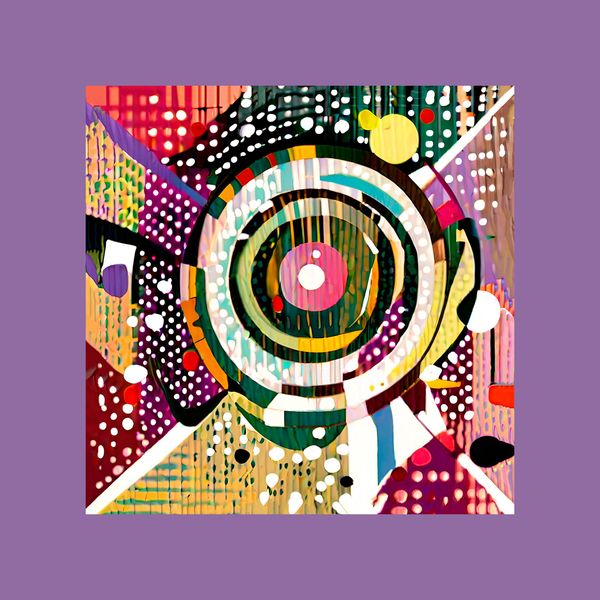
Phase 1 introduces the foundational circle as a point of origin. The composition balances symmetry with scattered motion: dots, angular fragments, and layered textures orbit the central form, suggesting early instability and the first stirrings of development. The palette mixes lavender, yellow, green, and red in a way that feels exploratory — a visual environment where structure is beginning to assert itself but hasn’t yet taken full control. This piece marks the initial spark of evolution, where form begins to gather intention.
Printed on archival, museum‑grade canvas using pigment-based inks by one of the top fine‑art printing studios in America. This studio produces work for artists, galleries, museums, corporations, art fairs, and professional designers, ensuring exceptional durability and color accuracy. Each artwork is mounted on a Float-Frame and is ready to hang.
Year Created
2026
Location
Denver, CO, USAColors
PurpleGreenRedTanPale Yellow
Materials & Tools
Adobe PhotoshopCanvas
Search Terms
originemergenceearly motionconcentric formcirclesgeometric tensionexploratory colorabstract evolutioncolor field
View Profile
Ken R Crost
Denver, CO, USA
I create abstract works that explore how motion, contrast, and spatial tension shape emotional experience. Each piece begins with a simple gesture — a curve, a sweep, a directional force — and expands into a study of how form can alter the field around it. My interest lies in the internal architectures that govern perception: the quiet geometries beneath feeling, the invisible pressures that guide how we move through visual space.
Color functions as both structure and energy in my work. High‑contrast pairings generate friction, while gradients and arcs soften that friction into movement. These interactions reveal how opposing forces can coexist within a shared momentum, creating compositions that feel simultaneously stable and unsettled. I use abstraction not to obscure meaning, but to expose the underlying dynamics that representation often hides. At its core, my practice investigates how difference creates motion — how one form pulls against another, how one color reshapes its counterpart, how tension becomes a generative force